
This post is a special one from EditMate’s Creative Director, Rachel King. Drawing on years of working closely with employer branding teams at companies big and small, Rachel shares insights from the book Unreasonable Hospitality and what it can teach us about creating memorable experiences, both for candidates and employees alike.
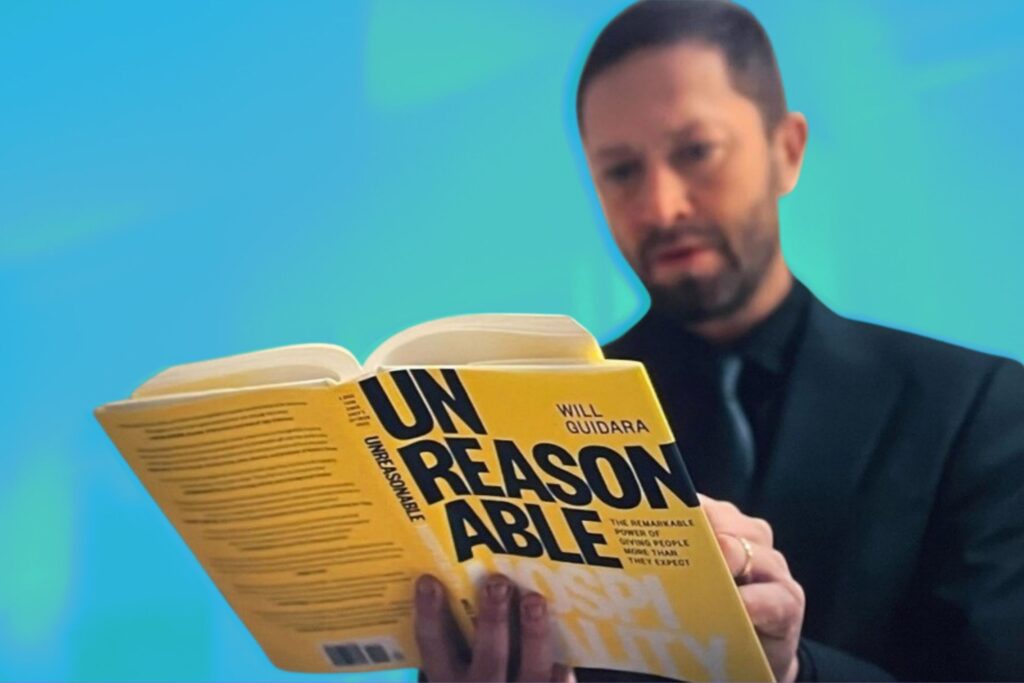
A few years ago (after learning about it from one of my favorite TV shows, The Bear), I read the book “Unreasonable Hospitality” written by restaurateur Will Guidara.
In it, he shares lessons from his time running the world-renowned Eleven Madison Park.
The book shows how going beyond excellent service to create thoughtful, human moments can make any interaction unforgettable.
I was reminded of the book recently after reading about the new Disney CEO and his emphasis on “Experience Intelligence” and specifically, how:
“The experience intelligent leader recognizes that a person’s experiences create lasting feelings, these feelings drive behavior, and the behaviors drives outcomes. To net extreme positive outcomes, the leader must create extreme positive experiences.”
And all of that got me thinking about employer branding.
Because most employer branding is… fine.
Polished. On-brand. Approved by 6 stakeholders.
And often, completely forgettable.
In the book, Guidara makes a simple point: being great isn’t enough anymore, you have to be memorable.
So, I thought I’d do a deep dive and share lessons EB teams can learn from the principles of Unreasonable Hospitality. And I want this to be useful for anyone who shapes the reputation of an employer: HR, talent acquisition, hiring managers, marketers, Chief People Officers, and others, too.
I’m including actionable takeaways any organization can put to work to create more memorable experiences for both job candidates AND employees.
So, here are 10 ways to apply Unreasonable Hospitality to employer branding:
1. Stop optimizing for information. Start optimizing for feeling.
Most EB teams focus on:
- “What do candidates need to know?”
- Benefits, perks, policies, job descriptions
That’s service.
Hospitality asks: How do we want people to feel when they interact with us?
Make it actionable:
- Define 3 emotional outcomes (e.g. “seen”, “excited”, “safe”)
- Audit your careers page, job posts, and candidate comms against them
- Cut anything that feels generic or templated
If it could belong to any company, it’s not doing its job.
2. Design moments, not just journeys
Candidate “journeys” are useful. But they’re often too linear and forgettable.
What people actually remember are moments:
- The email that felt human
- The interviewer who went off-script
- The unexpected follow-up
Make it actionable:
- Map your funnel (apply → interview → offer → onboarding)
- Identify 1 “moment that matters” in each stage
- Upgrade it with something small but thoughtful
💡 Example: Instead of a standard rejection email → send a personalized note referencing something specific they shared.
3. Train your team to notice, not just execute
At Eleven Madison Park, the magic didn’t come from scripts. It came from paying attention.
Employer branding is the same.
The best insights are hiding in:
- Candidate comments
- Interview feedback
- Slack messages
- Exit interviews
Make it actionable:
- Create a simple “insight capture” habit for recruiters and hiring managers
- Ask: What did this person care about that we didn’t expect?
- Turn those into content themes or experience improvements
Your best content strategy is already happening in conversations.
4. Empower people to go off-script
Unreasonable hospitality doesn’t work if everything needs approval.
If your recruiters and hiring managers are stuck copying templates, you’ll never stand out.
Make it actionable:
- Give guardrails, not scripts
- Create a “safe to personalize” zone in comms (emails, DMs, follow-ups)
- Encourage small, human deviations
💡 Example: Let recruiters send a quick Loom video instead of a templated update.
It’s faster. And way more memorable.
5. Be intentionally extra (in a way that actually matters)
This is where people get it wrong.
“Going above and beyond” doesn’t mean spending more money.
It means being more specific.
The famous hot dog story (see video below) from Eleven Madison Park worked because it was:
- Personal
- Unexpected
- Timely
Make it actionable:
- Pick 1 audience (e.g. early-career hires, retail staff, engineers)
- Identify something uniquely meaningful to them
- Build a small, repeatable gesture around it
Generic perks are invisible.
Specific gestures get talked about.
If you watch The Bear you know the scene where Cousin does this with a Chicago Deep Dish Pizza — I also had to include this because I love Cousin:
6. Turn one great idea into a repeatable system
A single great candidate experience is luck.
A repeatable one is strategy.
Guidara didn’t just create moments, he built systems so his team could do it consistently.
Make it actionable:
- Document your best candidate or employee experiences
- Break them into steps
- Turn them into playbooks your team can reuse
If it only happens when your “best person” is involved, it’s not scalable.
7. Treat employees like guests (not just talent)
Hospitality doesn’t stop after the offer is signed.
If anything, that’s where it matters most.
Employees are:
- Your storytellers
- Your content engine
- Your credibility
Make it actionable:
- Audit your internal moments: onboarding, promotions, anniversaries
- Ask: Would someone want to share this?
- If not, redesign it
The best employer brands aren’t built in campaigns.
They’re built in everyday experiences.
8. Make it easy for people to share the experience
If something great happens but no one talks about it… it doesn’t scale.
Unreasonable hospitality works because it creates stories.
Employer branding teams should be doing the same.
Make it actionable:
- Identify moments worth sharing
- Give employees an easy way to capture them (prompt, template, quick ask)
- Don’t over-produce it! Authenticity > polish
You’re not just creating experiences.
You’re creating content triggers.
9. Measure what actually matters
You can’t track “magic” perfectly. But you can track signals.
Move beyond:
- Clicks
- Views
- Applications
And look at:
- Candidate feedback quality
- Offer acceptance sentiment
- Employee-generated content
- Referral rates
Make it actionable:
- Add 1 qualitative question to your candidate or new hire surveys: “What stood out to you most?”
- Look for patterns
That’s your hospitality working.
10. Don’t just be better. Be different.
Most employer branding teams are benchmarking against each other.
That leads to sameness.
Unreasonable hospitality is about doing things people don’t expect.
Make it actionable:
- Look at your competitors’ careers pages and content
- List what everyone is doing
- Do the opposite (in a thoughtful way)
Safe = invisible.
Different = memorable.
The takeaway
Employer branding doesn’t need more content.
It needs more intention.
More noticing.
More personality.
More moments people didn’t see coming.
Because at the end of the day, candidates won’t remember your EVP framework.
They’ll remember how your company made them feel.
One last thing
If you do want to turn these moments into content (and you should), video is where this really compounds.
Not overly polished brand videos.
Real moments. Real people. Real stories.
That’s where something “unreasonable” turns into something scalable.
And where employer branding actually starts to work.
I hope this was useful and sparks a few ideas. Thanks for reading!
– Rachel from EditMate