

How enterprise People Brand teams can turn employee voices into a scalable talent attraction channel
Your employees are already telling your company’s story.
They’re talking about their work with friends. Posting about promotions on LinkedIn. Sharing conference photos. Answering questions from people in their networks who are thinking about applying.
The opportunity isn’t to make employees start advocating for your company.
It’s to make it easier for them to do more of it.
That’s the idea behind employee advocacy: giving employees the structure, support, content, and encouragement to share their own experiences and perspectives in ways that help your employer brand reach more of the right people.
And there’s a particularly important reason to do this now:
People want to hear from people.
Corporate employer brand messaging can tell candidates what a company says it’s like to work there. Employee advocacy gives them a chance to hear what it’s actually like from the people living it.
And when that perspective comes through video, candidates don’t just read what an employee thinks.
They can see them, hear them, and get a much better sense of the person behind the story.
So, to create this guide, we surveyed five leaders who have worked on employee advocacy programs at large organizations.
Their programs aren’t identical, and that’s exactly why we wanted to hear from them.
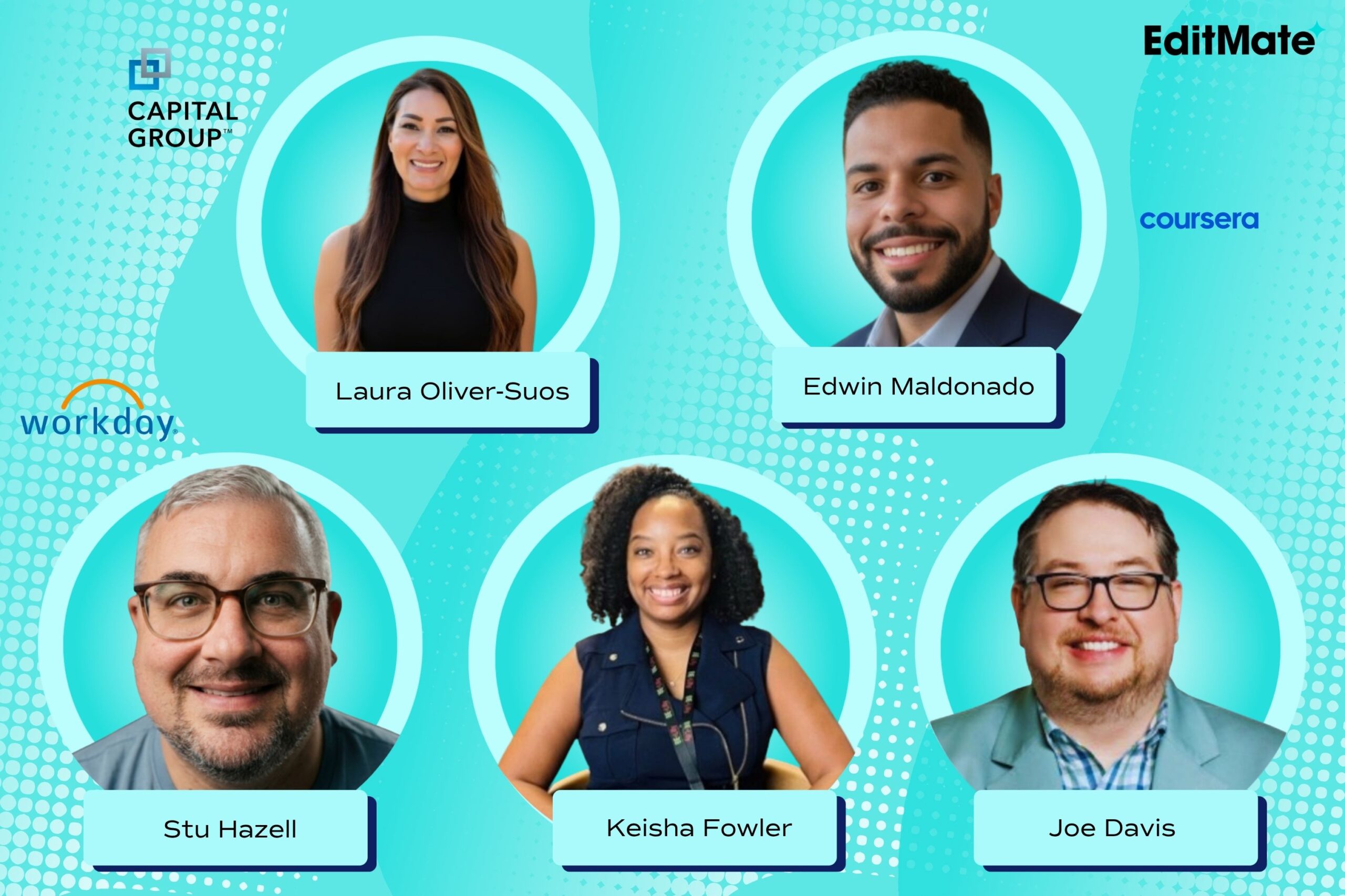
Meet the Leaders

Stu Hazell
Global Director, Talent Brand and Marketing at Workday

Laura Oliver-Suos
AVP, Talent Brand & Recruitment Marketing at Capital Group

Edwin Maldonado
Culture & Community Lead at Coursera

Keisha Fowler
Associate Director, Recruitment Marketing & Employer Branding

Joe Davis
Social Communication Strategist & Employee Advocacy Leader
Together, they bring experience from different stages and approaches to employee advocacy—from relatively small, community-led programs to more established enterprise programs and, in Joe Davis’s case, an enterprise program that grew to more than 13,000 signups.
We asked them what they’re doing, what they’ve learned, what motivates employees to participate, what challenges they’ve encountered, how they measure success, and what they’d tell another People Brand leader starting from scratch.
And what came through was surprisingly consistent.
What We Heard
Across the five surveys, interviews, and conversations, a few clear patterns emerged:
- Start with a real business problem.
- Start small and learn before you scale.
- Make participation voluntary.
- Give employees structure without taking away their voice.
- Make participation as easy as possible.
- Measure both program health and business impact.
And perhaps most importantly:
- The employee’s perspective is the product.
This guide takes those lessons and turns them into a practical, multi-step framework you can actually use to build — or improve — an employee advocacy program at your organization.
First: What Employee Advocacy Actually Means
Let’s make one distinction first.
There are two very different versions of employee advocacy.
Version 1: “Here’s a post. Please share it.”
This is the traditional model.
Your social team creates content. Employees receive the content. They share it with their networks.
There’s nothing inherently wrong with this.
But there’s another opportunity…
Version 2: “Here’s a platform. Tell us your story.”
This is where employee advocacy becomes employee-generated content.
Instead of asking employees to simply distribute your employer brand, you give them opportunities to create it.
That might mean:
- A video about why they joined the company
- A post about a career milestone
- A photo from a team event
- A story about learning something new
- A quick take on their area of expertise
- A “day in the life” video
- A behind-the-scenes look at a project
- A personal perspective on company culture
The difference is important.
Distribution turns employees into a media channel.
Creation turns employees into storytellers.
And the second one is where employee advocacy gets really interesting for People Brand teams.
Keisha Fowler put it simply:
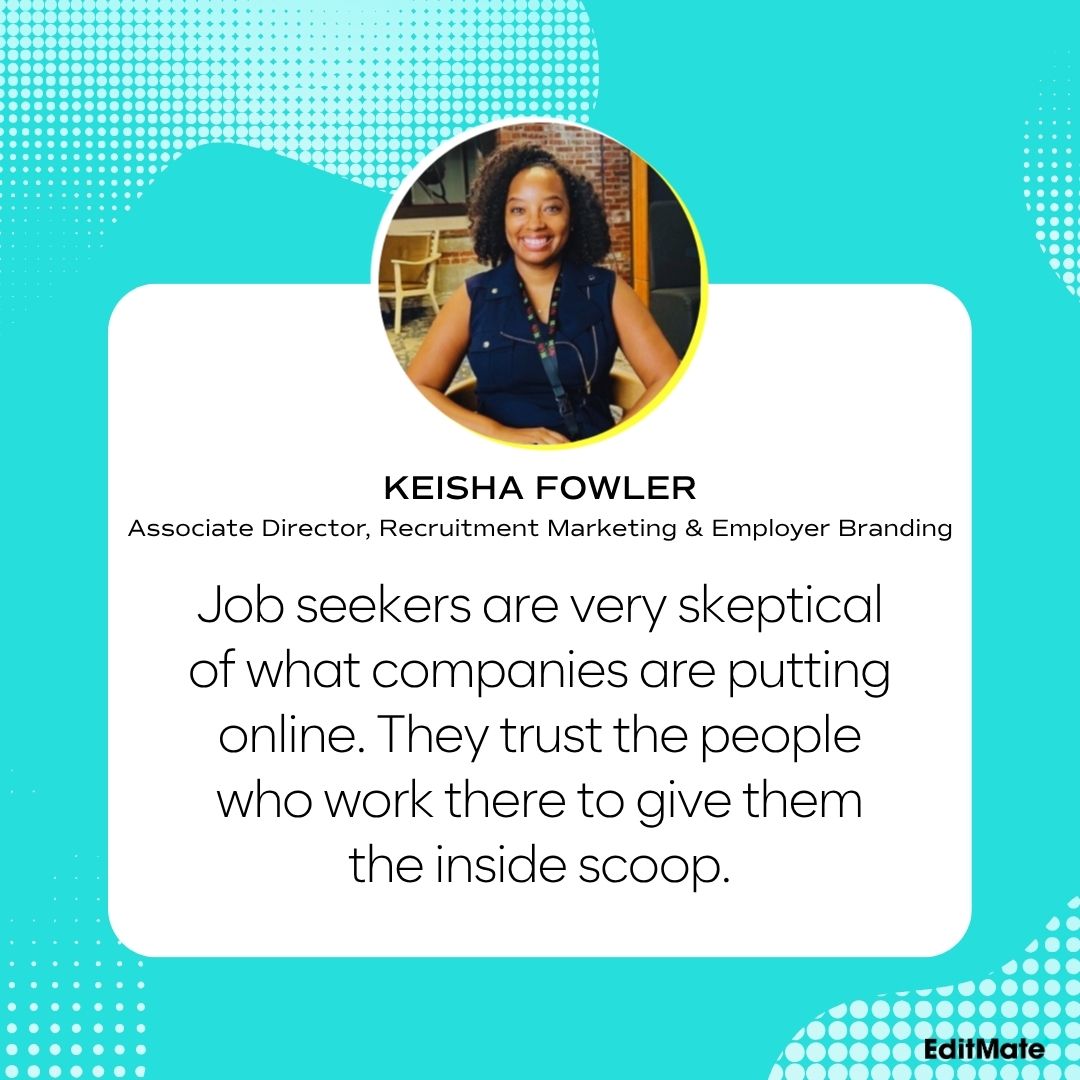
That’s the opportunity.
The guide will help you create a employee advocacy program that can give candidates something your careers page can’t always provide: the employee perspective.
Now, let’s walk through the steps:
Step 1: Start With the Business Problem, Not the Program
This might be the most important piece of advice in the entire guide.
Don’t walk into a leadership meeting and say: “We should start an employee advocacy program.”
That’s a solution looking for a problem.
Instead, start with: “We’re trying to solve X. Here’s where employee advocacy could help.”
Capital Group‘s Laura Oliver-Suos put it perfectly:
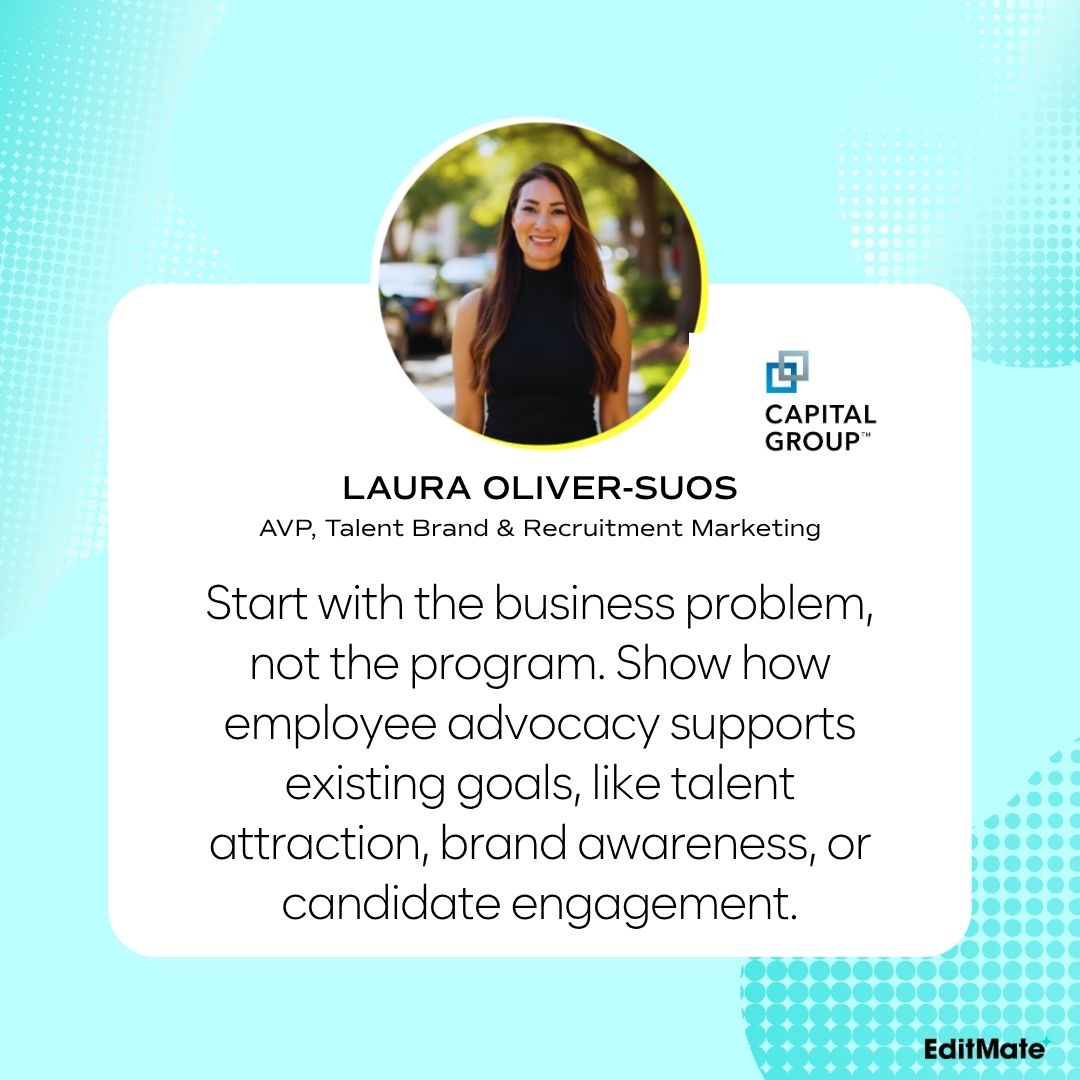
That’s a much easier conversation to have.
Your problem might be:
- We’re struggling to differentiate ourselves in competitive talent markets.
- Candidates don’t understand what it’s actually like to work here.
- Our corporate social channels reach people, but not enough of the right talent.
- We need more authentic employer brand content.
- Our employees have great stories, but we’re not capturing them.
- We need to strengthen employee engagement.
Employee advocacy can support all of these.
But your business case should start with the problem you’re already trying to solve.
Your action
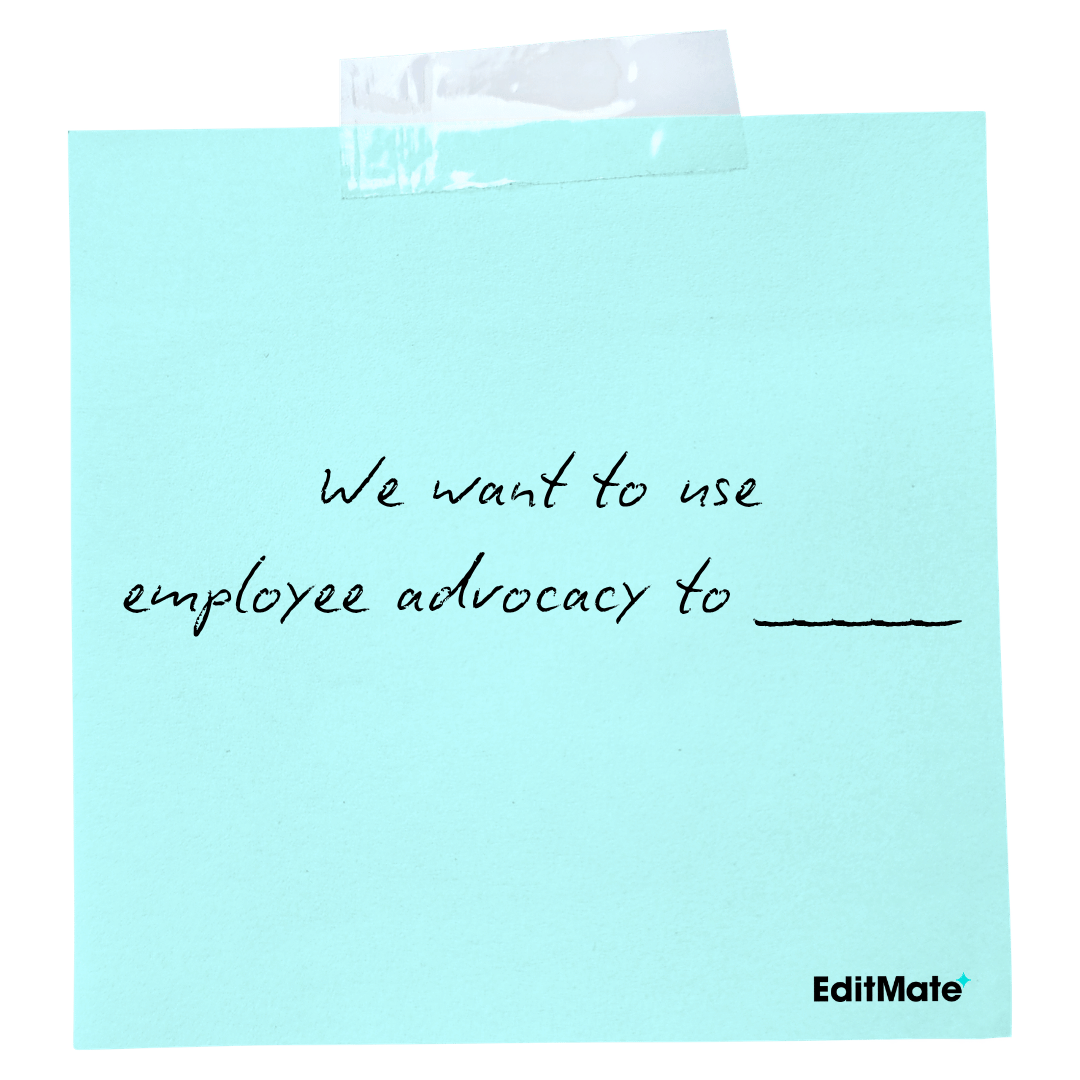
Write one sentence:
“We want to use employee advocacy to ________.”
Then identify 2–3 metrics that would tell you whether you’re making progress.
That’s your starting point.
Step 2: Make the Candidate the Center of the Program
One of the strongest reasons to build employee advocacy is also one of the simplest:
People want to hear from people.
Keisha’s perspective is particularly useful again here: “They trust the people who work there to give them the inside scoop.”
That gives you a useful test for every piece of advocacy content.
Instead of asking:
“Does this say something positive about our company?”
Ask:
“Does this answer a question a candidate actually has?”
For example:
Candidate question:
“What is career growth actually like there?”
Employee advocacy response:
“I started here as a recruiter three years ago. Here’s what happened next…”
Candidate question:
“What does this job actually involve?”
Employee advocacy response:
“A lot of people think I’m doing X all day. Here’s what my actual week looks like…”
Candidate question:
“Do people really like working there?”
Employee advocacy response:
“The thing I didn’t expect to love about working here was…”
This is where employee-generated content becomes particularly powerful.
You’re not just amplifying positive messages.
You’re answering the questions candidates are already asking.
Joe Davis shared with us this “How I Reboot” video from H&R’s employee advocacy program, which celebrated their annual Reboot Week, a week where all employees take the week off to recharge. This video does the job of answering candidate questions about company culture, what work/life balance looks like at H&R Block and what are the people like, who work there.
Step 3: Get the Right People in the Room
Employee advocacy sits in an interesting spot.
It touches employer brand, social, communications, HR, talent acquisition, employee experience, corporate brand… and sometimes Marketing.
That can make ownership messy.
It can also make your program much stronger.
At the organizations represented in this guide, programs involved different combinations of Employer Brand, Corporate Brand, Corporate Social, People/HR, Talent, Recruitment Marketing, and leadership.
The takeaway?
Don’t build the program in a silo.
Stu Hazell from Workday shares this advice:
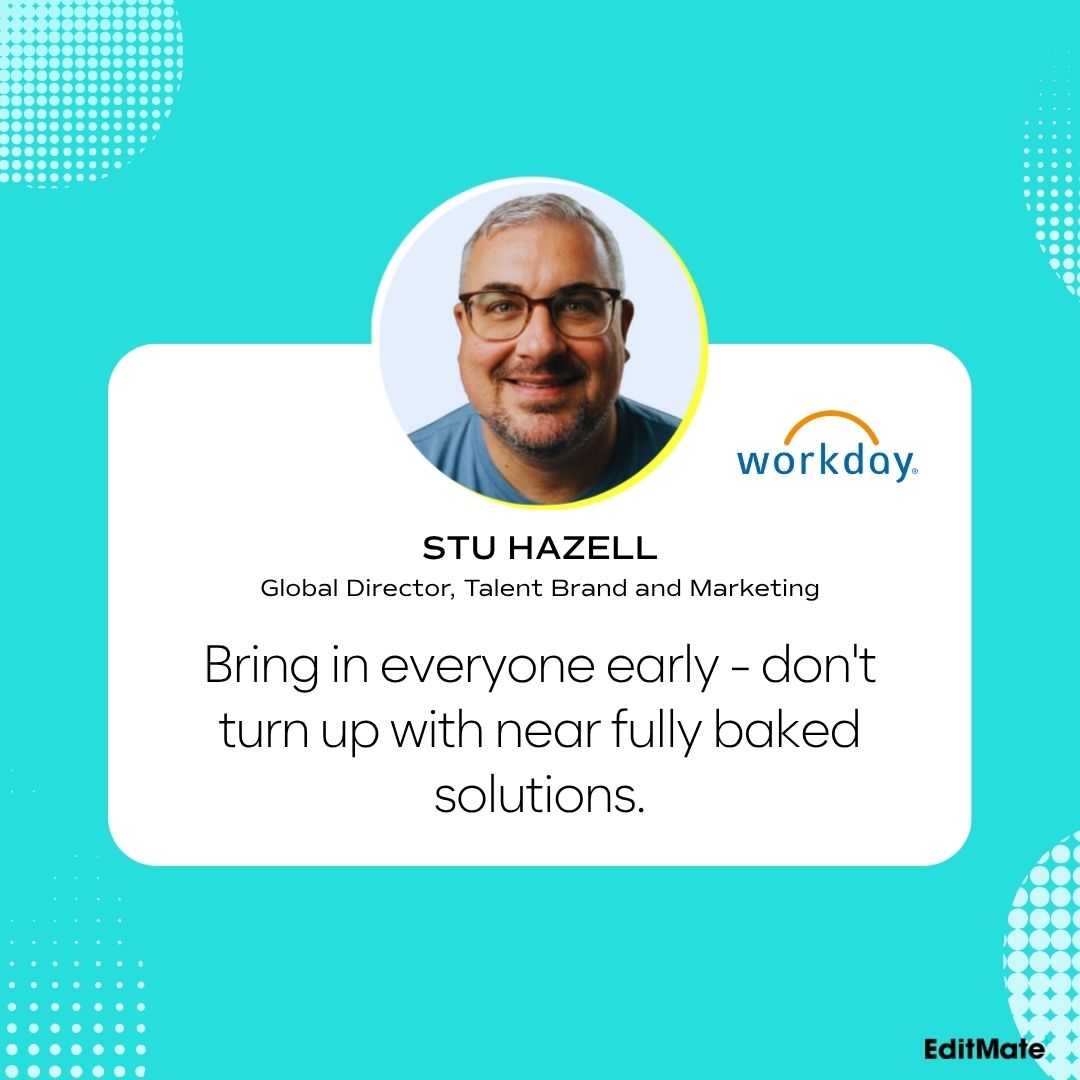
That’s excellent advice for enterprise organizations in general.
Your stakeholders don’t need to agree on every detail on day one.
But they should understand:
- What problem you’re solving
- Why employees are part of the solution
- What you’re asking employees to do
- What success looks like
- How you’ll pilot it
- What you need from each team
Your action
Build a small working group. At minimum, consider:
Program owner: Employer Brand / Talent Marketing / TA
Partners:
- Corporate Social
- Internal Communications
- Corporate Brand
- HR / People
- Recruiting
- Legal, if necessary
Executive sponsor: Someone who can help remove organizational roadblocks.
You don’t need a committee of 20 people.
You need the right people early.
As Joe Davis advises:
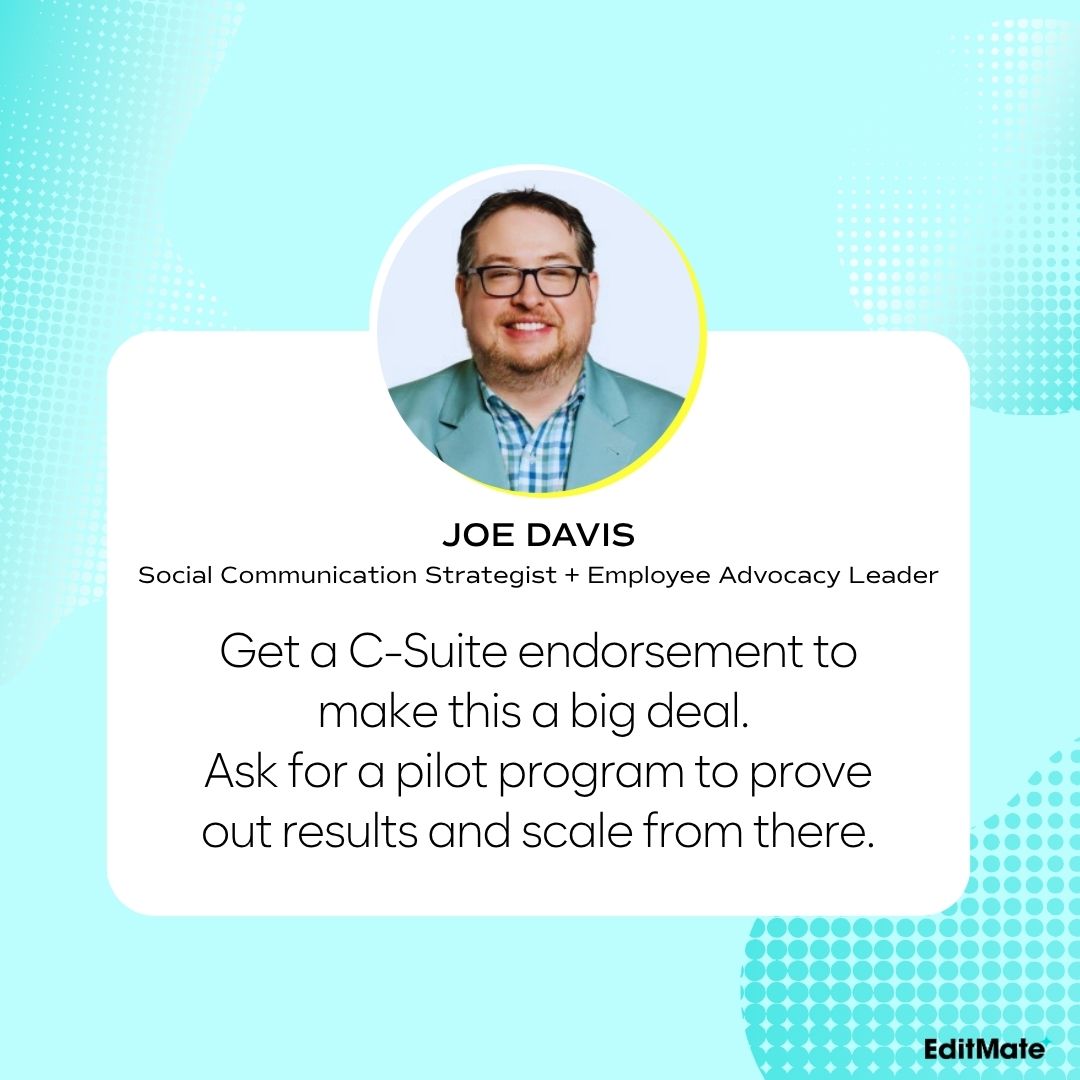
And that bring us to…
Step 4: Don’t Start With 10,000 Ambassadors
One of the biggest mistakes teams can make is thinking scale has to happen immediately.
It doesn’t.
Coursera‘s Edwin Maldonado also recommends starting with a pilot:
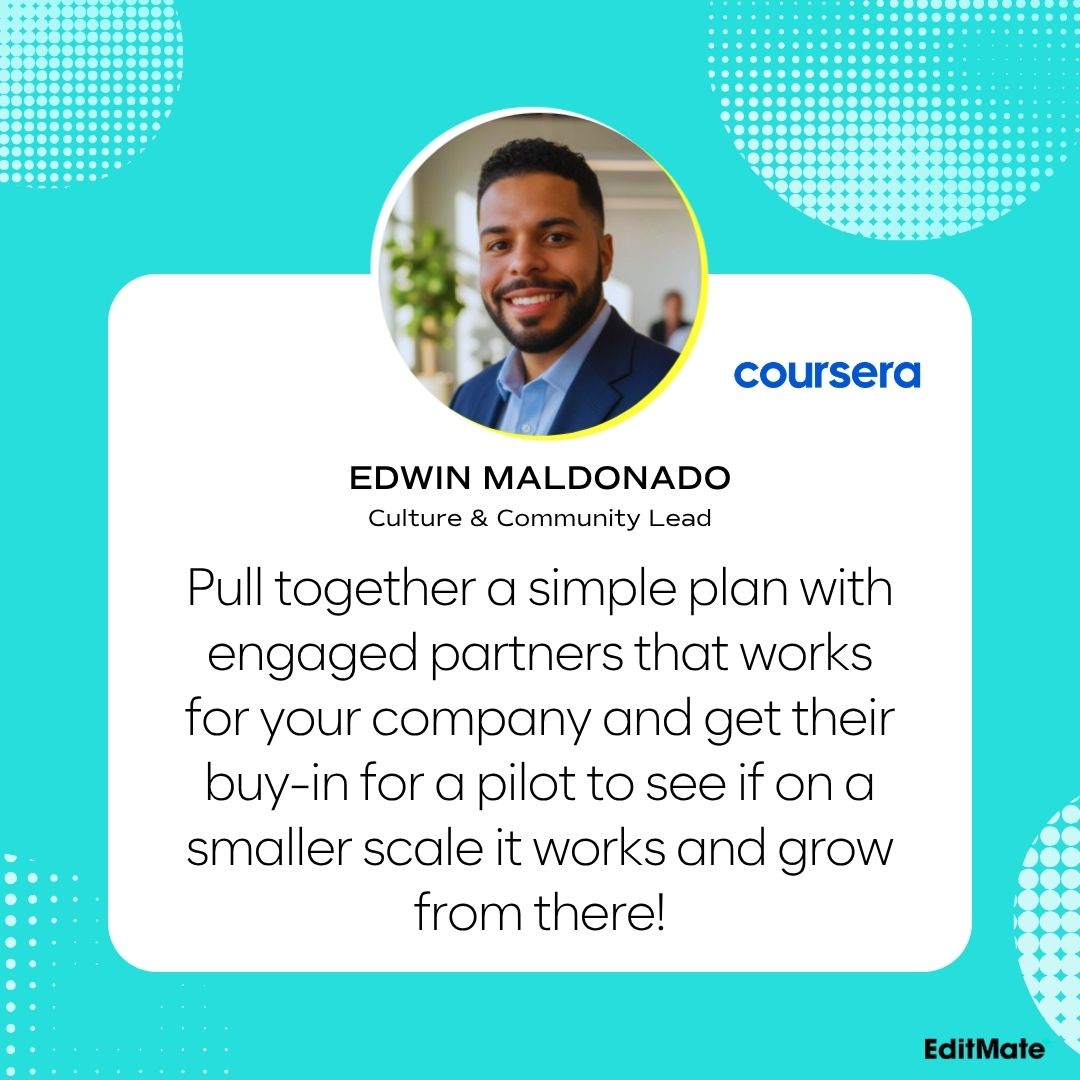
Capital Group took a similar approach, beginning with a pilot cohort representative of its global workforce.
And Keisha’s current program is intentionally small, with 1–10 active participants.
A small program gives you a chance to figure out:
- Who actually participates?
- What content do employees want to create?
- What training do they need?
- What prompts get responses?
- What makes employees come back?
- What does the approval process look like?
- What does leadership want to see?
- What metrics matter?
- How much work does the program actually create?
You can learn all of that with 25 employees much more easily than 25,000.
But starting small doesn’t mean you should build a program that can only stay small.
Joe Davis’s experience at H&R Block shows the next stage of the journey. The program grew to more than 13,000 signups, with roughly 95% coming from field associates, alongside participation from corporate teams. His advice for getting there is straightforward: get executive endorsement, pilot first, test and learn, communicate KPIs, and scale what works.
That gives you a useful progression:
Pilot → prove → systematize → scale.
Your first cohort
A good pilot might be 5–50 employees representing different:
- Functions
- Locations
- Levels
- Tenures
- Business units
- Employee experiences
You don’t need “influencers.”
You need people with stories.
Step 5: Make Participation Voluntary
Here’s another place where the leaders’ we surveyed experiences are pretty consistent:
Capital Group: Fully voluntary
Coursera: Fully voluntary
Keisha’s program: Fully voluntary
Workday & H&R Block: Encouraged but optional
That’s not a coincidence.
Employee advocacy works because employees are lending you something you can’t manufacture: their credibility.
Forcing someone to post about their employer is a pretty effective way to make the post feel like an ad. And that defeats the point.
Instead, make participation desirable. Give employees something useful in return.
That could be:
- Professional visibility
- Personal brand development
- New skills
- Networking
- Recognition
- A chance to celebrate their work
- A platform for their expertise
- A way to help other candidates understand the company
At Capital Group, Laura Oliver-Suos says:
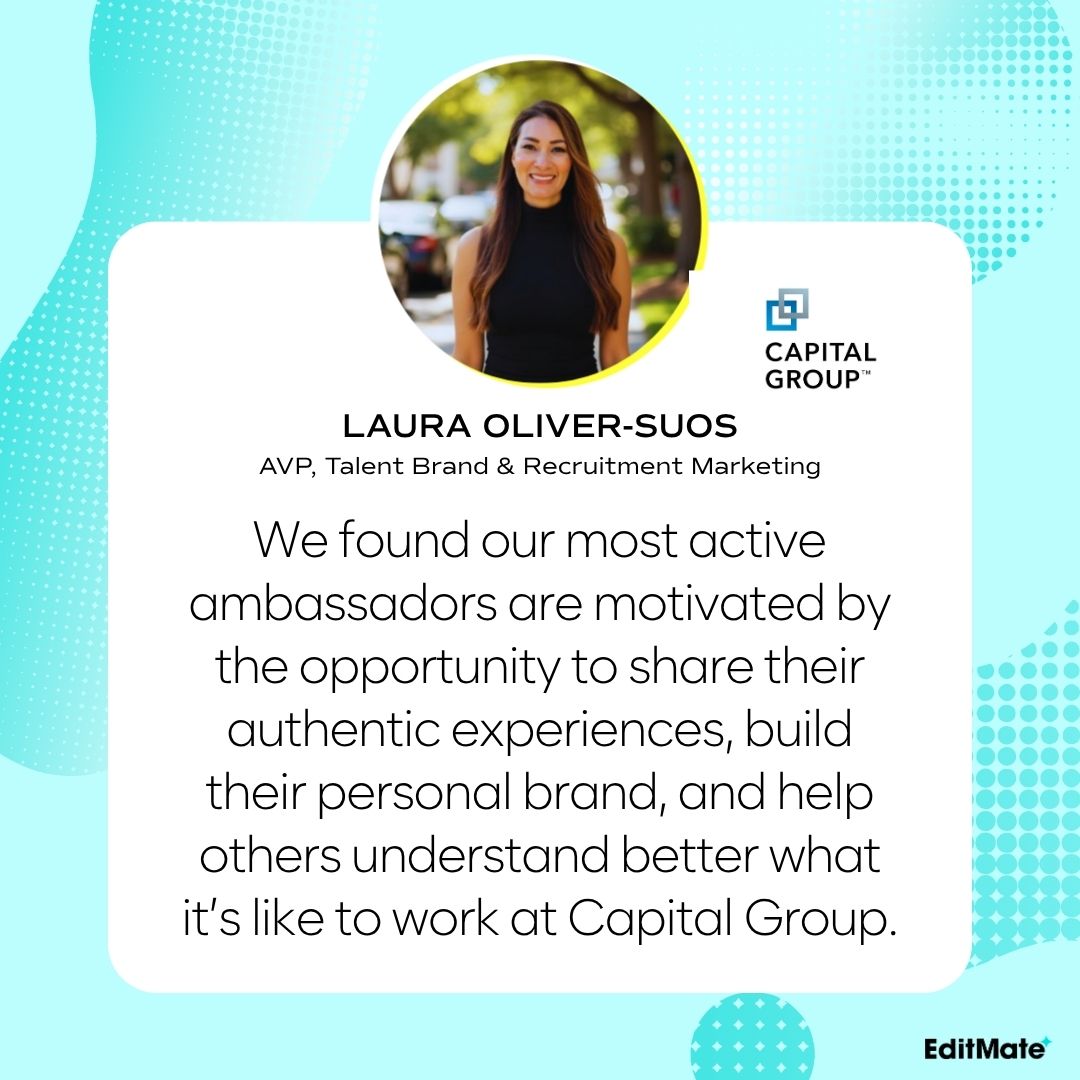
Coursera’s most active contributors are motivated by the ability to share accomplishments.
At Workday, contributors are motivated by the opportunity to share content with their peers.
The common thread?
Employees need a reason to want to participate.
Your action
Don’t ask:
“How do we get employees to post?”
Ask:
“Why would an employee want to participate?”
Build the program around that answer.
Step 6: Give Employees Guardrails, Not Scripts
This is where advocacy programs can go very wrong.
If an employee receives a perfectly polished corporate caption and a branded graphic and is told: “Please post this.”
You’ve created distribution. You haven’t created advocacy.
Edwin Maldonado from Coursera takes a particularly clear position:
Capital Group provides prompts, templates, and training while allowing employees to tell their stories in their own voice.
Workday uses prompts and scripts and supports employee-created content with editing.
Keisha’s program also uses prompts, templates, and training.
These approaches aren’t identical, but they share a principle:
Employees need help. But they don’t need to sound exactly like your social media team.
Give them prompts
Instead of:
“Tell us about your experience at the company.”
Try:
“What’s something you know now about working here that you wish you’d known before you joined?”
Or:
“What’s one thing your team does differently?”
Or:
“What’s a career lesson you’ve learned here?”
Or:
“What’s a project you’re proud of?”
Specific questions make storytelling much easier.
Give them examples
Show employees what good looks like.
Give them training
Especially for video.
Give them flexibility
Let employees decide how they want to tell the story.
View this post on Instagram
Another example from Joe: “This piece of content was from our EGC pilot where we gave internal creators a prompt and they executed on the brief. This worked well because it was relevant to the associate so she was passionate about it”
Your action
Create an Advocate Toolkit containing:
- Content prompts
- Examples
- Brand guidelines
- Social guidelines
- Video tips
- Optional templates
- FAQs
- Submission instructions
Think toolkit, not rulebook.
Step 7: Make Video a Core Part of the Program
This is where employee advocacy gets especially interesting for People Brand teams.
A LinkedIn post can tell candidates something. A photo can show them something.
Video can let them hear and see the person telling the story.
That’s a different level of connection.
And employee-generated video doesn’t need to mean expensive production. In fact, the point is often the opposite.
The employee’s phone, personality, surroundings, voice, energy, and little imperfections are part of what makes the content believable.
That doesn’t mean “anything goes.” There’s a sweet spot between: overproduced corporate video and a shaky 47-second video recorded in terrible lighting with the employee whispering from their car.
Your job as the People Brand team is to make the middle ground easy.
Workday’s experience gives us a great example:
Stu Hazell highlighted that this piece of content that performed particularly well because it was:
- Well shot
- Supported by strong B-roll
- Emotive
- Relevant to a clear target audience
- A mix of video and photography
That’s a useful lesson:
Authenticity doesn’t mean abandoning quality.
It means the employee’s perspective stays at the center.
Give employees a simple video framework
- Hook
“Three years ago, I never would have imagined I’d be doing this…”
2. Story
“Here’s what happened…”
3. Takeaway
“The thing I didn’t expect was…”
4. Invitation
“If you’re considering a career here, here’s what I’d want you to know…”
That gives employees structure without putting words in their mouths.
Give them easy prompts
Try:
“Why did you join?”
“What surprised you?”
“What’s something you’re proud of?”
“What does a typical day actually look like?”
“What’s one thing people misunderstand about your job?”
“What has helped you grow here?”
“What would you tell someone considering applying?”
These are simple questions.
But simple questions are often where the good stories are.
Step 8: Don’t Confuse Employee-Generated With Employee-Edited
This distinction matters.
Your employees should own the story.
They don’t necessarily need to own the entire production process.
That’s particularly important if you’re trying to scale employee-generated video.
An employee can provide a 90-second video from their phone.
And then, working with a professional video editor, a People Team can turn that footage into:
- Short-form social videos
- Recruiting campaign assets
- Careers-site content
- Employee spotlights
- Recruitment ads
- Internal content
- Event content
- Talent campaign content
The employee remains the storyteller.
The professional editing makes the story easier to consume.
That’s a powerful middle ground.
Authenticity comes from the source. Quality comes from the system.
Step 9: Build a Content System, Not a Collection of Random Posts
Once you’ve got employees willing to participate, the next challenge is consistency.
You don’t want:
January: “Let’s launch employee advocacy!”
February: Three posts.
March: Everyone forgets about it.
The answer is a repeatable content system.
Workday is moving toward more programmatic rigor around its employee-driven content, including content streams, planning meetings, and templates across its talent brands.
That’s an important evolution.
The goal isn’t simply to collect content.
It’s to build a content engine.
Start with 5–7 content pillars
Career Growth
- Promotions
- Learning
- Mentorship
- Career pivots
Day-to-Day
- What I actually do
- Team routines
- Behind the scenes
Culture
- Events
- Traditions
- Employee communities
Mission
- Why the work matters
- Customer impact
- Purpose
People
- Colleagues
- Leaders
- Team stories
Expertise
- Industry insights
- Conference takeaways
- Professional advice
Life at [Company]
- Personal experiences
- Unexpected moments
- “Things I wish I’d known”
Then create a monthly prompt calendar. Now employees don’t have to think: “What am I supposed to post?”
They can simply choose something that feels relevant to them.
Step 10: Create an Employee-Generated Video Flywheel
Here’s a particularly useful way to think about employee-generated video:
Prompt → Capture → Edit → Publish → Employee Shares → Audience Engages → Learn → Prompt Again
One employee video could become:
→ 3 short social clips
→ 1 LinkedIn post
→ 1 careers-site story
→ 1 recruiting campaign asset
→ 1 internal communication
→ 1 recruiting-event asset
That is where employee advocacy starts becoming more than a social tactic.
It becomes a content supply chain for your People Brand team.
And that’s particularly valuable for enterprise organizations, where the challenge isn’t necessarily coming up with stories.
It’s producing enough good content to tell those stories consistently across markets, roles, and talent audiences.
Step 11: Make Participation Ridiculously Easy
When asked Keisha Fowler what surprised her about running an employee advocacy program, she said:
That’s a very real enterprise-program lesson.
The program may look simple from the outside: “Employees post things.”
But behind that can be:
- Recruitment
- Reminders
- Content prompts
- Follow-ups
- Approvals
- Editing
- Distribution
- Measurement
- Reporting
- Relationship management
If participation requires employees to remember five steps and navigate three systems, participation will drop.
Keisha suggested: “I would make it easy. Perhaps use a platform that participants can log into and pick a message, fill in the blanks and send.”
That’s exactly the right mindset.
Ask yourself:
How many steps does it take an employee to participate? Then start removing them.
Your goal should be: See prompt → choose story → create → submit → done.
The less friction, the more likely employees are to come back.
Step 12: Give Employees Something to Gain
You don’t necessarily need financial incentives. In fact, none of the organizations represented in this research relies on traditional financial incentives as the primary reason employees participate.
Instead, employees can benefit from the program itself.
Think about:
Professional brand
Employees get visibility for their expertise.
Recognition
Feature them on company channels.
Skill building
Teach storytelling, video, social media, and personal branding.
Community
Create a community of ambassadors who can learn from one another.
Purpose
Give employees a way to help future colleagues understand the organization.
And if you want to add a little friendly competition, both Keisha Fowler and Joe Davis offer useful ideas.
Keisha suggests:
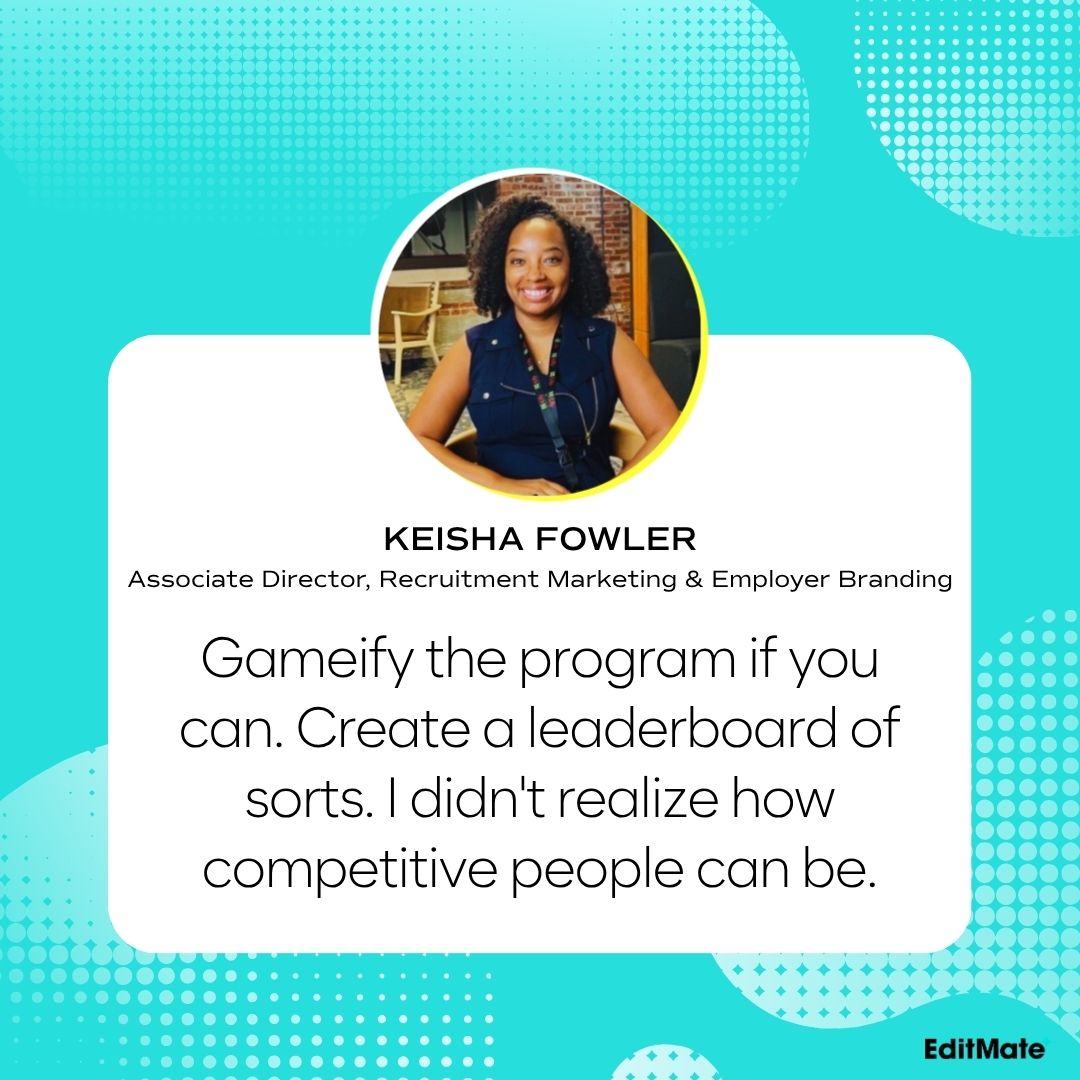
And Joe’s experience shows what that can look like at scale. At H&R Block, advocacy contests were run multiple times during tax season, with different ways to participate, leaderboards, random drawings, and rewards for top performers.
You don’t have to turn employee advocacy into a game show. But recognition, leaderboards, badges, shout-outs, contests, or small rewards can add some energy… especially once you have enough participation to make it fun.
More importantly, incentives should reinforce the reasons employees already have to participate. Joe found that advocacy could benefit employees’ own personal brands and, for field associates, support business development and talent acquisition.
Step 13: Build a Champion Network
Once an advocacy program grows, the program owner can’t be the person responsible for every reminder, question, training session, and piece of encouragement.
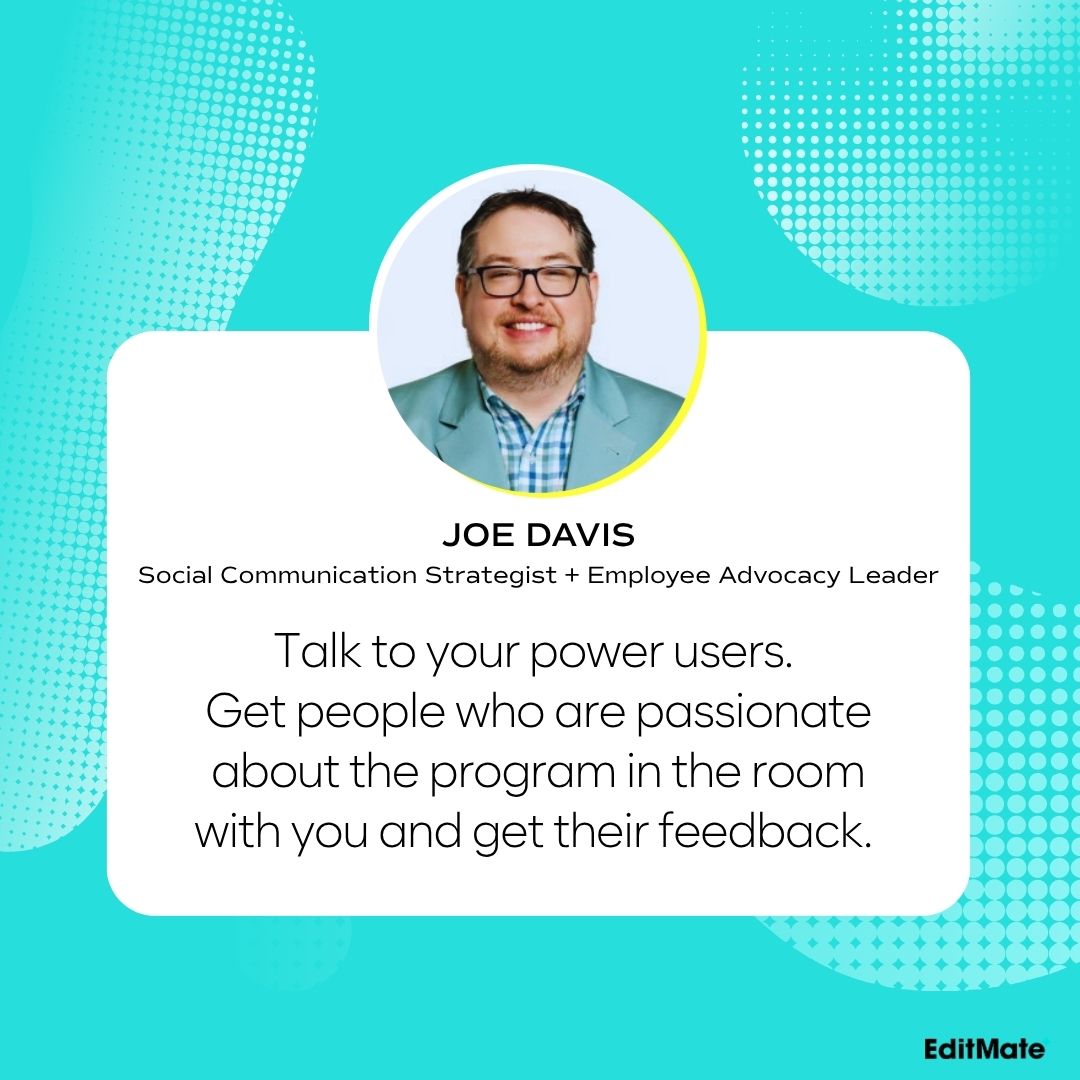
Joe Davis’s experience at H&R Block offers a useful model: build a network of local or regional champions who can help cascade information, tasks, and motivation to other advocates.
This changes the operating model.
Instead of:
Program team → every employee
You can move toward:
Program team → champions → advocates
Champions can help:
- Share new prompts and program updates
- Encourage participation within their teams or markets
- Surface questions and pain points
- Identify strong storytellers
- Help onboard new advocates
- Reinforce deadlines and campaigns
- Share what is working locally
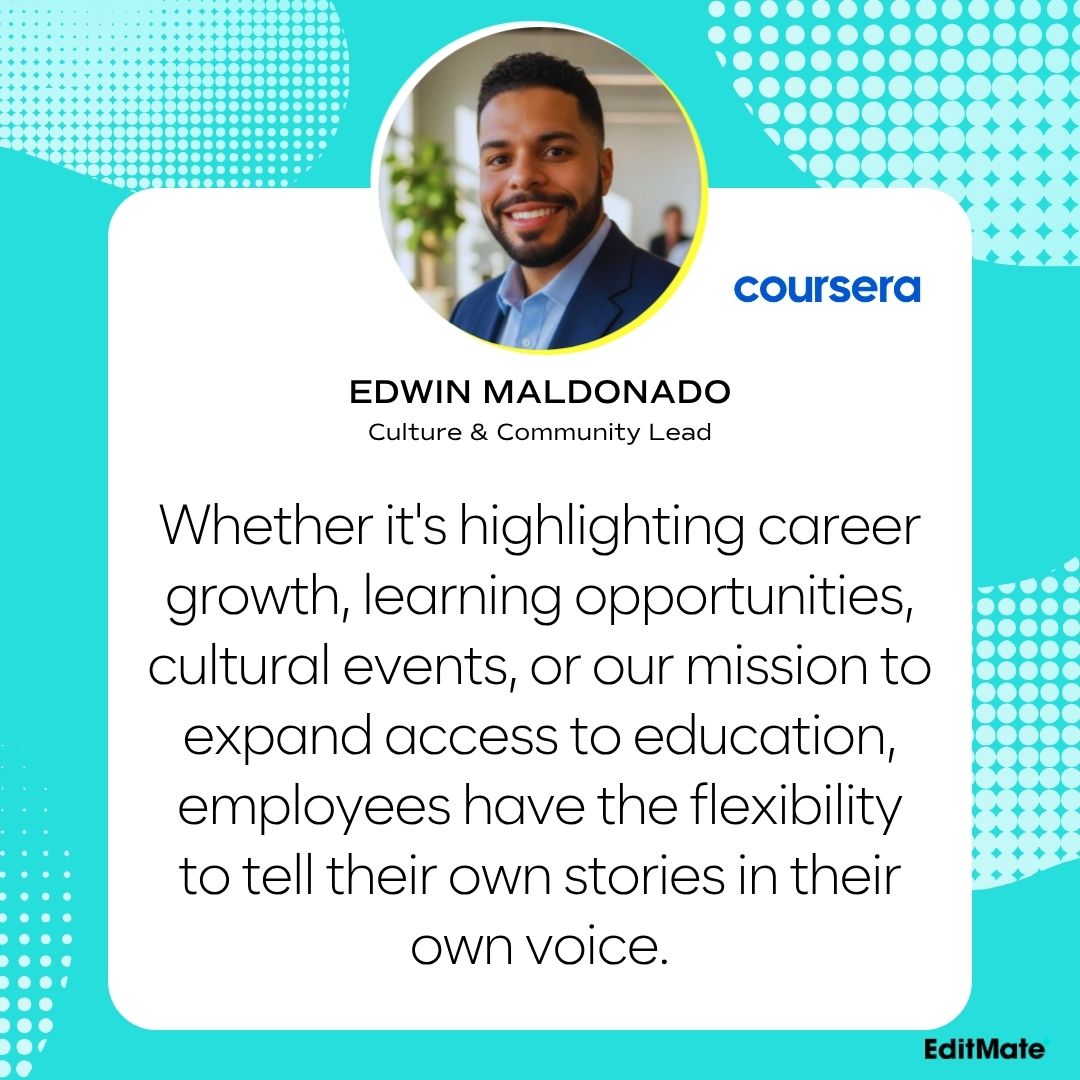
At Coursera, Edwin shared that they elevate employee advocacy through their Community Resource Groups (CRGs) as part of their broader Global Culture & Community Strategy.
He detailed, “Our CRGs also serve as culture ambassadors, partnering across the business to help amplify key initiatives, reinforce our leadership mindsets, and support talent attraction in authentic ways. This approach allows advocacy to grow organically from the employee experience rather than feeling like a standalone campaign.”
Your action
Once your pilot is working, identify your most engaged advocates.
Ask:
“Who would other employees naturally go to for advice or encouragement?”
Those people may be your first champions.
The goal isn’t to create another layer of bureaucracy. It’s to create a distributed network that helps the program feel closer to employees while making it easier for the central team to scale.
And don’t assume you know what advocates need.
Joe’s experience also points to the value of asking participants directly about their pain points, desired content, and barriers to participation. At enterprise scale, your advocates are one of your best sources of program feedback.
A useful rule:
Step 14: Measure Both the Program AND the Brand
If you want your advocacy program to survive budget season, you’re going to need more than impressions.
Start with two buckets:
A. Program health
Measure:
- Number of ambassadors
- Activation rate
- Participation rate
- Number of posts
- Number of employee creators
- Repeat creators
- Content submissions
- Growth of participation
Workday specifically tracks growth of contributors, growth of distributors, engagement, and repeat creators. These are useful because they tell you whether you actually have a functioning program. Not just a one-time campaign.
B. Employer brand impact
Then measure:
- Reach
- Impressions
- Engagement
- Follower growth
- Sentiment
- Careers-site traffic
- Talent audience engagement
- Applications
- Candidate source
- Employee referrals
But don’t fall into the trap of measuring something just because it’s easy to measure.
Keisha made an important point regarding this:
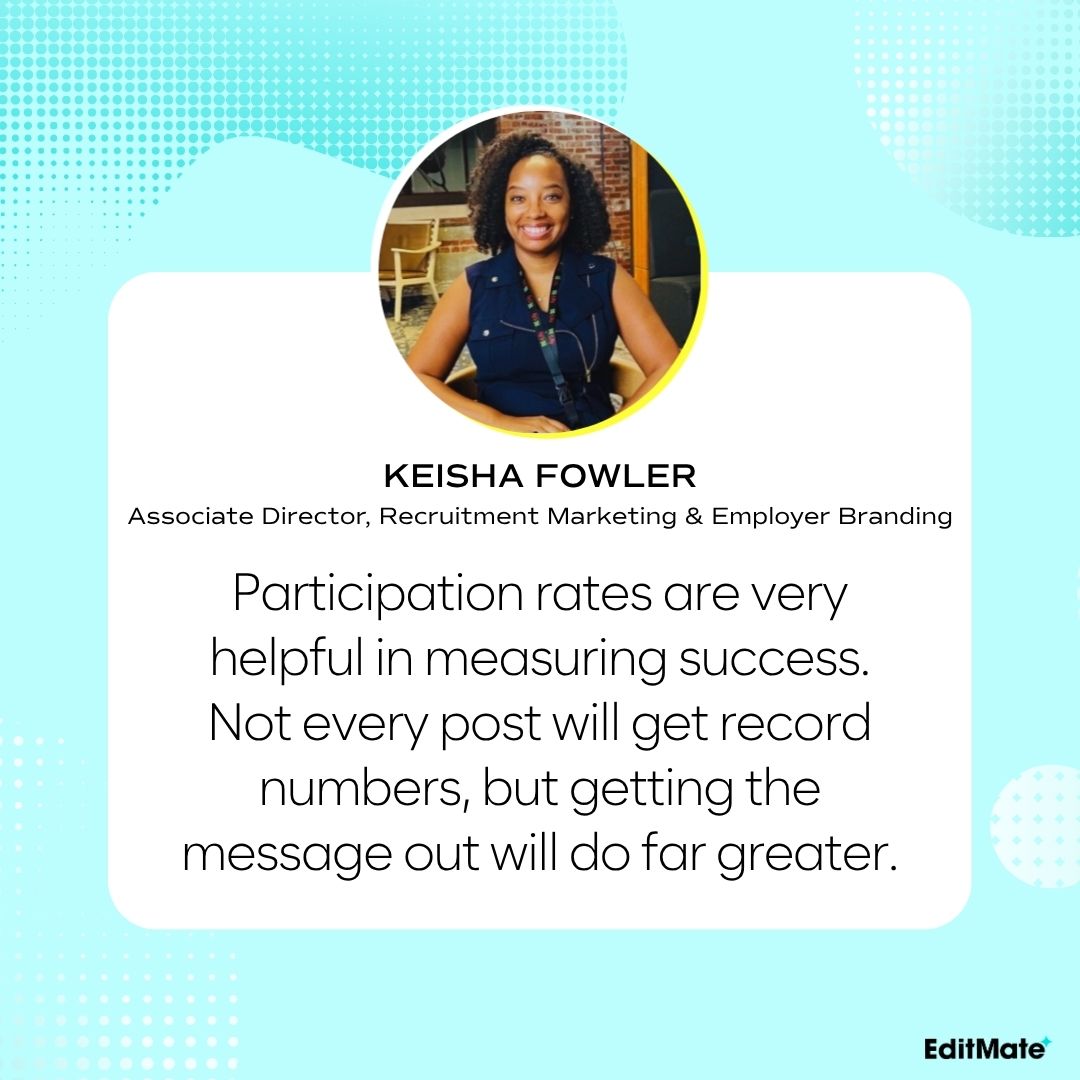
In other words: Don’t judge the entire program by the performance of individual posts.
You’re building a channel. Look for patterns.
Step 15: Don’t Underestimate the Employee Engagement Benefit
Here’s one of the more interesting insights from the research.
Employee advocacy isn’t only an external employer brand strategy. It can also be an internal employee engagement strategy.
Capital Group considers employee engagement an important metric because participation is voluntary.
Laura explains:
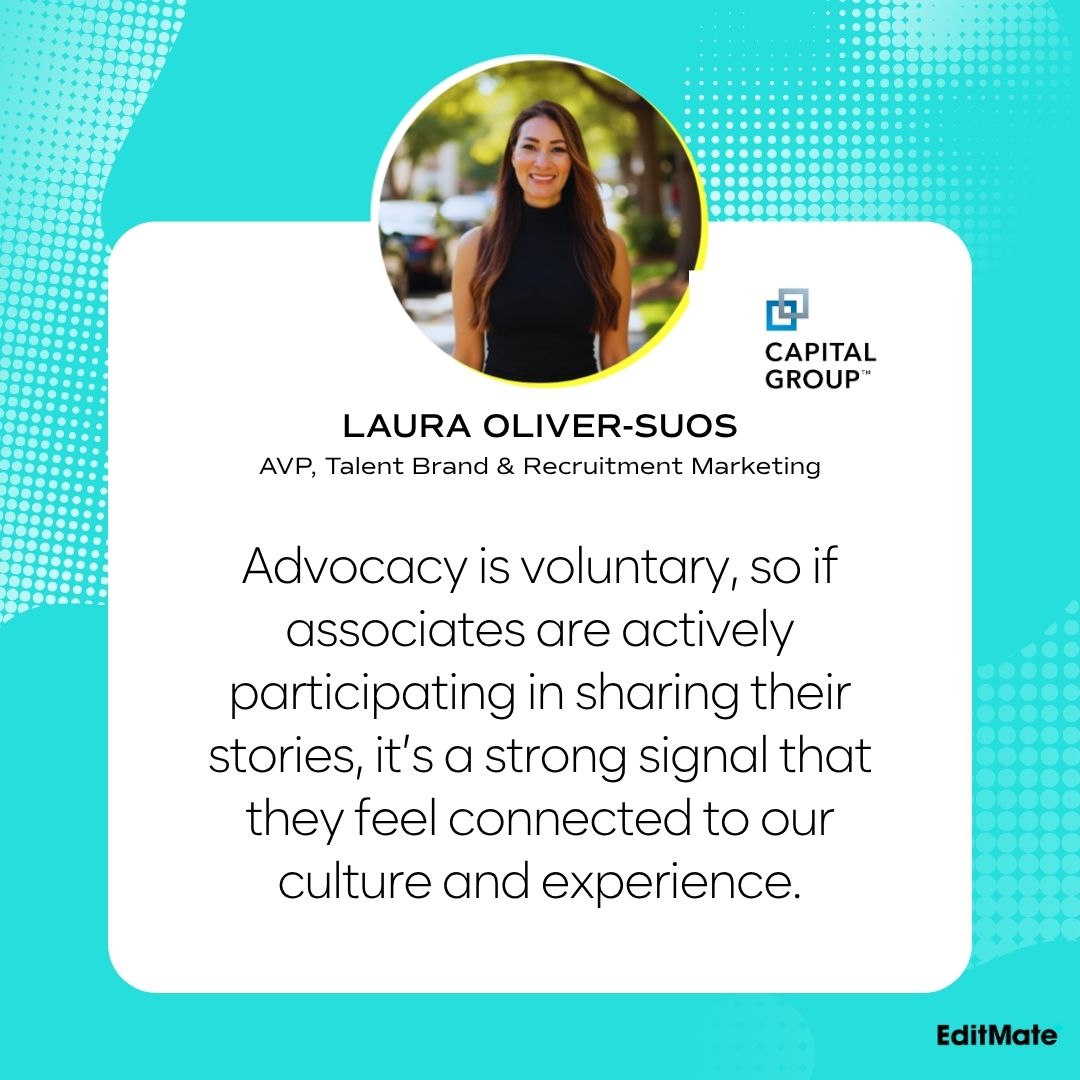
And Edwin from Coursera has seen “Employee buy-in and want for involvement.”
That’s a pretty powerful outcome.
When employees want to participate, they’re not just helping your employer brand. They’re telling you something about their relationship with the company.
Step 16: Launch With a 90-Day Pilot
If you’re taking this guide to your boss, here’s the part you can actually put on a slide:
Weeks 1–2: Define
- Identify the business problem
- Establish 2–3 goals
- Identify executive sponsor
- Bring in Social, Brand, HR/People and TA partners
- Define success metrics
- Agree on employee participation guidelines
Weeks 3–4: Recruit
- Identify 25–50 potential ambassadors
- Recruit a representative cohort
- Explain what’s in it for employees
- Create ambassador community/channel
- Build your Advocate Toolkit
Weeks 5–6: Enable
- Run an onboarding session
- Provide social guidance
- Provide storytelling prompts
- Run a short video training
- Share examples
- Explain the content workflow
Weeks 7–10: Create
Launch a small number of recurring prompts.
For example:
1: Why I joined
2: What I actually do
3: Something I’m proud of
4: What surprised me
Encourage employees to choose their format: Text / Photo / Video — Don’t require everyone to do everything.
Weeks 11–12: Measure
Look at:
- Participation
- Repeat participation
- Content volume
- Engagement
- Reach
- Employee sentiment
- Talent brand signals
- Careers traffic
- Applications, where measurable
Then ask the most important question:
“What did we learn?”
Not: “Did this go viral?”
The Big Idea for Employee Advocacy Programs
Throughout our research, across every conversation and interview we did, the same idea kept coming up:
Employee advocacy works when you make it easy for real people to tell real stories.
Start with a real business problem.
Start small.
Keep participation voluntary.
Give employees structure, not scripts.
Make creating and sharing easy.
Measure participation, engagement, and business impact.
Then build the system to scale.
Because employees don’t need you to give them a story.
They already have one.
Your job is to create the questions, tools, support, and systems that help them tell it.
And when those stories come through video, candidates don’t just read about your culture. They can see the people behind it.
That’s the opportunity:
Less corporate messaging. More employee voices.
Less control. More credibility.
Less one-off content. More of a system.
Your employees already have the stories.
Build the system that helps those stories travel.
Keep Going
Want to put these ideas into action?
See how leading teams are using video to turn employee voices into powerful employer brand content.
Explore more case studies, watch real examples, and see how EditMate can help you build a video system that makes employee advocacy easier to create, scale, and share.